


Page 11 - Edmonton Antique Car Club
P. 11
ty workmanship, durability, power, and innovation.  In   a 24 1/2 mile climb up Hamilton Mountain (that bisects
        1906, REO sales tripled to 2,458 cars, Oldsmobile with   Hamilton, Ontario) in an hour and five minutes, another
        their new larger models had sold 1,600 and Henry Ford had  REO had completed a five-mile race in Ottawa at 53 mph,
        sold 1,599.  In 1908, REO sold 4,105 cars to 1,035 for   and a REO became the first car to drive from Saint John,
        Oldsmobile; REO was number 3 in sales after Ford and   New Brunswick to Halifax, Nova Scotia and back.
        Buick.  The curved dash Oldsmobile had continued to sell
        reasonably well until it was discontinued in 1907; the new      For 1912, Ransom offered a completely new model
        larger Oldsmobiles had not done well and by 1908 the com- in addition to the Model 30: the REO Special touring car.  It
        pany was a million dollars in debt.  William Durant was   was much more up-to-date with smooth sides and doors all
        shopping for brands to add to Buick to create a multi-brand  around with top and windshield now standard on a 112 inch
        corporation to be known as General Motors.  His first   wheelbase with 34 x 4 inch tires and demountable rims.  Its
        choices were REO, Ford, and Maxwell.  Both Ransom Olds  four-cylinder engine produced 35 hp.  The car’s black paint
        and Henry Ford were willing to sell, but they wanted cash   was set off by nickel trim, and an acetylene self-starter sys-
        deals and Durant was offering a share position in the new   tem was available for $30 extra.  The REO Special was
        General Motors.  Ransom and Henry turned that down.    priced at $1,500 in Canada and $1,055 in the U.S.  In the
        Durant then bought Oldsmobile from the Smiths for $2 mil- U.S., the REO Special was also known as REO “The Fifth,”
        lion in stock in the new company, added Cadillac and Oak- being the fifth distinct car Ransom had designed.  Ransom
        land in 1909, and General Motors was launched.  How dif- considered it “not only the finest car that he could ever de-
        ferent the American automobile market may have been had  sign, but also the final word in automobile design.”  He
        REO and Ford become part of the General Motors startup in  referred  to it as “My Farewell Car.”  Thereafter he would
        1908.                                                 be less involved in the design of future models.

                In 1906, Ransom had organized the Capital Nation-     Ransom had one more epic adventure in his story,
        al bank.  It’s name was later changed to Lansing National   the 1912 trans-Canada journey.  Thomas W. Wilby was a
        Bank and then Michigan National Bank.                 popular British journalist. The year before he had driven
                                                              from New York to San Diego and back and knew there was
                Ransom introduced improved designs for 1908, but  money and glory in writing and lecturing about the experi-
        REO lost market share gradually thereafter to Ford’s new   ence.  Wilby approached Ransom Olds with what he con-
        Model T and General Motors.  REO would remain profita-
        ble, though, until the Depression.  Ironically, in spite of
        Ransom’s initial belief in inexpensive cars, REO became a
        mid-market brand similar to Oldsmobile.  In 1909, REO
        branched out into trucks for which the brand is best remem-
        bered today.  They became well known for strength and
        durability.  The REO Speedwagon set the standard for pow-
        er, durability, and quality workmanship.  They would be
        used for fire trucks, tow trucks, dump trucks, delivery
        trucks, busses, hearses, and ambulances.

                The REO Motor Car Company of Canada Limited
        began manufacturing cars early in 1909, ironically in the St.
        Catherines, Ontario, plant in which Oldsmobiles had been
        built from 1905 to 1907.  Canadian born Richard H. Scott
        (1868-1944), an associate of Ransom at REO in Lansing
        who had worked with him on developing his gasoline en-
        gines in the 1890s, was instrumental in launching this Cana-
        dian initiative.  The first units offered were two-cylinder
        lightweight models that were merely assembled with little
        real manufacturing, rated at 20-22 hp, and priced at $1,250
        for a roadster or touring.  The first cars built completely in
        the factory were the new four-cylinder 1910 models.  They
        were known as the Model 30 for the 30 hp output of the
        engine and the steering wheel had been moved to the left.
        It cost $1,500 for either the roadster or touring but top and
        windshield were still extra.  Little was changed for 1911,
        but three new models were introduced: a proper four-door
        touring for $1,575 and a limousine and a landaulet at $2,400
        each.  The Canadian company indulged in a bit of promo-
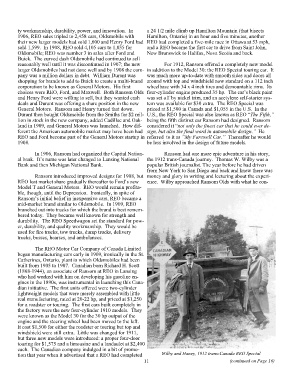
        tion that year when it advertised that a REO had completed   Wilby and Haney, 1912 trans-Canada REO Special
                                                             11                                  (continued on Page 16)

